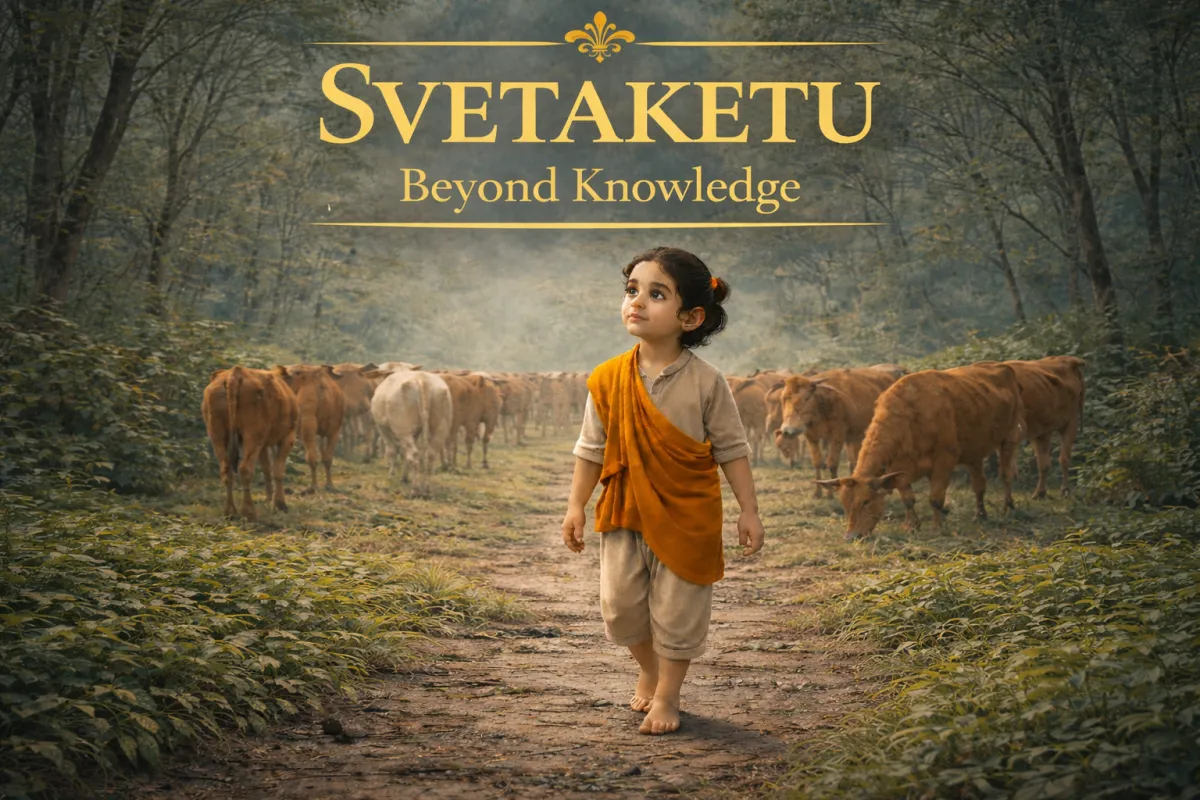
Svetaketu: The Boy Who Knew Everything
Svetaketu and the Cows
There was a boy whose name was Svetaketu.
The name itself carried meaning. Sveta means white. Ketu means a comet, a bright streak across the sky. Svetaketu was born into a family of Brahmins, not merely by birth, but by the way they lived.
In its true sense, Brahman means the ultimate.
A Brahmin is one who seeks that ultimate reality, not through labels, but through awareness.
This was such a family.
The Brilliant Student

When Svetaketu reached the age of twelve, he was sent to a master to study.
For twelve long years, he lived in the ashram.
He was sharp, intelligent, and gifted. Whatever was taught, he grasped immediately.
He learned the Vedas.
He learned the Upanishads.
He learned the Brahma Sutras.
Everything that could be said about human life, about existence, about what lies beyond, he learned it all.
These scriptures contained the highest knowledge known to humanity.
That is why they were also dangerous.
At the end of twelve years, the master said to him,
“There is nothing more for you to learn.
You have learned everything that can be learned.
It is better that you return home.”
The Father’s Shock

Svetaketu returned home confident, certain, filled with knowledge.
The way he walked showed it.
The way he spoke revealed it.
His father looked at him and said,
“You have come back as an ignorant fool.”
Svetaketu was stunned.
“Ignorant?” he replied.
“I know all the Vedas and the Upanishads. I can even recite them backwards.”
His father said,
“I know. Everything that can be learned, you have learned.
But that which learns, you know nothing about.”
He continued,
“You know everything that can be known,
but you do not know the knower.
The very way you walk tells me this.”
“We are Brahmins not by birth, but by awareness.
If you wish to remain here, you must know the knower, not just what can be known.”
And with that, his father sent him back.
The Second Journey

Svetaketu returned to his master and said,
“My father says I am ignorant.
I have learned everything you taught me sincerely.
But he says I must know the knower.”
The master smiled.
“For twelve years, you were interested only in what could be known.
So we taught you everything that could be known.
Now you want to know the knower, let us see.”
Then the master gave him a task.
“Take this herd of cattle into the forest.
There are four hundred cows.
Stay with them.
When they become one thousand, return.”
Nothing more.
No scriptures.
No study.
No instruction.
Just the cows.
Life with the Cows

Svetaketu could not believe it.
After twelve years of intense study, this?
It was like earning the highest degree, only to be told to become a cowherd.
At first, there was resistance.
His mind rebelled.
Thoughts raced endlessly:
Everyone has rejected me.
Even my master has abandoned me.
But the mind needs fuel to keep running.
And here, there was none.
Only the forest.
Only the cows.
Slowly, weeks turned into months.
There was no one to impress.
No one to teach.
No one to debate.
The cows did not listen.
They only ate.
Chomp. Chomp. Chomp.
That rhythm entered him.
Becoming Natural

Gradually, the scriptures loosened their grip.
The knowledge he carried had no audience.
Without someone to show it to, it lost its power.
When he was hungry, he ate.
When he was tired, he rested.
Nothing more.
They say the shape of his eyes changed —
they became soft, like the eyes of a cow.
With the cows, he became like the cows.
When he sat, he sat completely.
When he walked, he walked completely.
If he touched the earth, he became the earth.
If he leaned against a tree, he became the tree.
There was no effort.
Just presence.
Language slowly disappeared.
Numbers faded away.
He no longer knew whether the herd was four hundred or one thousand.
He was simply there.
The Return

One day, the cows came to him and said,
“We are one thousand.
Let us return to the master.”
Svetaketu walked back with them.
When they entered the ashram, the cows stood together —
and he stood among them.
The disciples rushed forward.
“Svetaketu has returned! Let us count the cows.”
They counted.
It was one thousand.

They ran to the master and said,
“It is one thousand. He has returned.”
The master replied,
“No.
It is one thousand and one.”
“The boy who left — full of knowledge and pride — is no longer there.
What has returned is not a person, but a quiet presence.”
The Teaching
Svetaketu had not gathered more.
He had fallen silent.
And in that silence, he had come to know the knower.
Not through effort.
Not through learning.
But by becoming utterly natural.
Final Note
Do not make everything into input.
Do not endlessly gather.
No matter how much you collect, the ultimate cannot be known that way.
Only when knowing falls silent,
presence begins.
